Best value
Wood
Lower to build, and a damaged section is a board and an afternoon rather than a panel order.
Best value
Lower to build, and a damaged section is a board and an afternoon rather than a panel order.
Longest life
It does not rot, and the surface does not need a finish to stay presentable.
Lowest maintenance
Wash it. There is no staining cycle and nothing to sand.
Our pick — Wood
| Criterion | Wood | Vinyl |
|---|---|---|
| Rots | ||
| Needs staining or sealing | ||
| Repair one damaged board | No — panel section | |
| Custom heights and shapes on site | Limited to the system | |
| Follows a slope easily | Yes, stepped or racked | System-dependent |
| Colour choice after install | Any stain | None — colour is the product |
| Brittle in hard cold | Can be | |
| Stains from mowing and mud | Hidden by finish | Shows, cleans off |
| Post work identical |
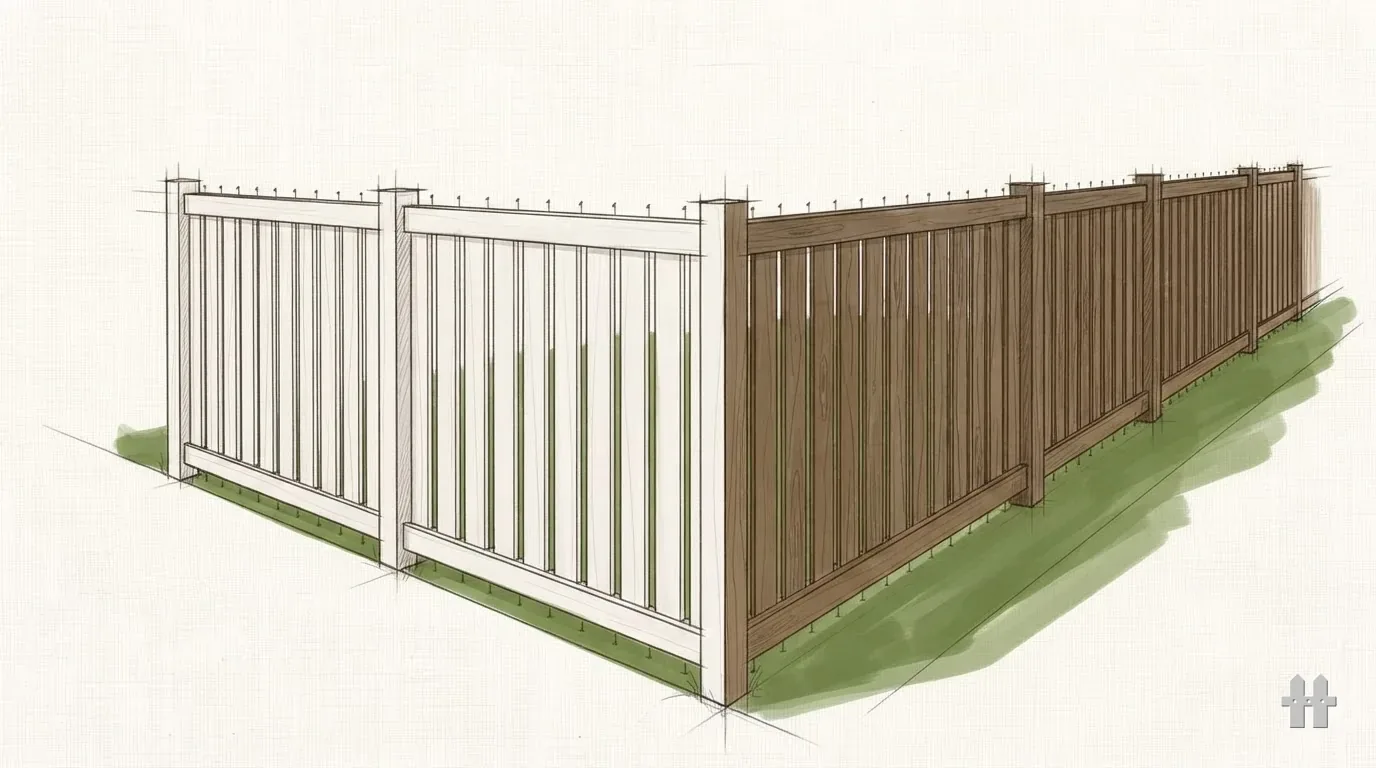
Boards on rails on posts. Cheapest to build, endlessly repairable, and it will look its age unless you keep after it.
PVC panels in routed posts. Higher up front, almost nothing after — and a panel system rather than a set of parts.
The deepest difference is not material, it is architecture. A wood fence is a set of parts: posts, rails, boards, screws. Any of them can be bought anywhere, cut to any length, and replaced individually. A vinyl fence is a system: panels sized to fit routed posts from one manufacturer's line.
That decides almost everything downstream. Custom heights, odd angles and awkward corners are trivial in wood and a special order in vinyl. Damage is one board in wood and a panel section in vinyl. And in ten years, wood boards will still exist while a particular vinyl profile may not.
A solid vinyl privacy panel is a sail. It presents an unbroken face to the wind and passes that load straight into the posts and their footings. Wood privacy fences do the same, but a wood fence has a well-understood failure mode: a board or a rail lets go first, which relieves the load and is cheap to fix.
With vinyl the panel is strong and the load goes to the post. Follow the manufacturer's post spacing and footing specification exactly — it is part of the engineering, not a suggestion, and it is often more demanding than what you would do for a wood fence of the same height. The general principles are in post depth, but the system's own instruction governs.
Wood fails gradually and visibly. It greys, checks, a picket works loose, a rail sags. Every stage is repairable, and at any point you can decide to spend a weekend and get most of it back.
Vinyl fails suddenly and locally. A mower throws a stone, a branch comes down, a car backs into it — and there is a cracked panel that cannot be filled, sanded or painted, only replaced. Cheap vinyl also chalks and yellows over years, and there is no recovering from that either, because the colour is the material.
Wood if the budget matters, if the yard has slopes, odd angles or heights, if you want to choose the colour, or if you would rather repair than replace.
Vinyl if you will not maintain a wood fence, if you want it to look the same in a decade with a hose, and if the run is straightforward enough that a panel system fits without fighting it.
As always, build both totals from your own quotes rather than from a per-foot number in an article — the method is in fence cost per foot.
Prices move weekly and by region. Enter the unit price your yard quoted you — the defaults are round placeholders, not a market average.
Nothing here is asserted as a current figure. This page compares properties and trade-offs, and says how to get your own number where a price would have gone.
Filed under Fence building — 11 tools, guides and comparisons in this pillar.
Price both over the same run with your numbers.
The whole-job view, including demolition.
If wood wins here, this is the next decision.
The half of the fence neither material changes.
The other no-upkeep fence, for when privacy is not the point.