Best value
Face screws
Cheapest per square foot, fastest to drive, and any board can be lifted with a driver.
Best value
Cheapest per square foot, fastest to drive, and any board can be lifted with a driver.
Longest life
Nothing to fail but the screw, and a loose one is retightened rather than replaced.
Lowest maintenance
No screw heads to back out, refill with water or bleed rust down the board.
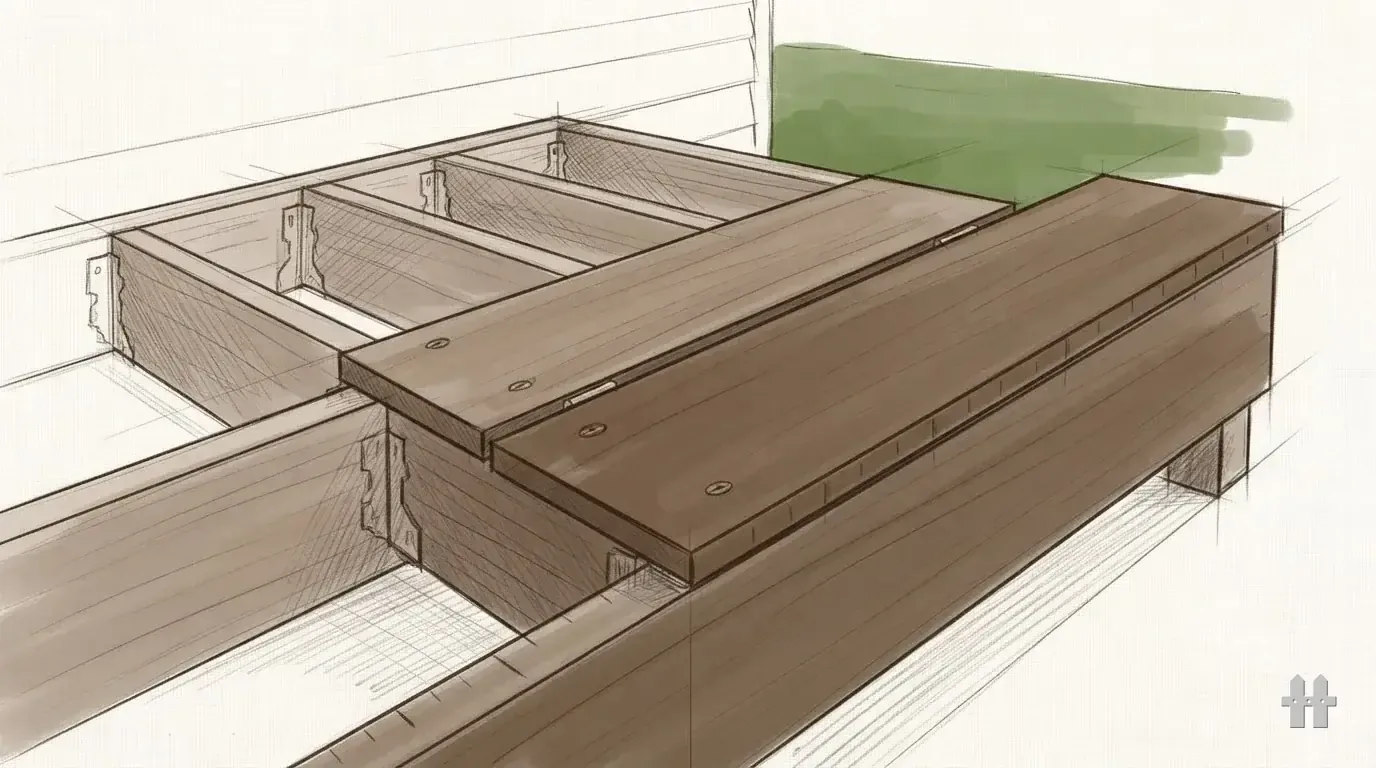
Our pick — Face screws
| Criterion | Face screws | Hidden clips | Plugs |
|---|---|---|---|
| Screw heads visible | Barely | ||
| Needs grooved board edge | Usually | ||
| Works with any board profile | |||
| Can lift one board mid-deck | Only from an edge, or cut | Drill out the plugs | |
| Butt joint still needs a face screw | n/a | Usually yes | n/a |
| Locked to one manufacturer | Board-matched | ||
| Retightenable later | After removing the plug | ||
| Corrosion rating critical |
Straight through the board into the joist. The default, the cheapest, and the only option that stays trivially serviceable forever.
Seated in a groove in the board edge and fixed to the joist. Clean surface, slower install, and the board's groove ties you to the system.
Face screws countersunk and capped with a matching plug. The screw's holding power with most of the clean look.
Most hidden fastener systems seat in a groove machined into the edge of the board. That means the fastener question is really a board question, settled when you pick the decking — an ungrooved board rules most clip systems out, and a grooved one commits you to a compatible clip.
It also commits you to a manufacturer. Clips and grooves are not interchangeable across brands. In five years, matching a board and its clip means finding both still in production.
With face screws, lifting a board mid-deck is two minutes with a driver — to replace a damaged board, run a cable, chase a leak, or look at a joist you are worried about. Put it back with the same screws.
With hidden clips, boards interlock in sequence. Removing one in the middle means either working back from an edge or cutting the board out and repairing the run. Most people never need to; the ones who do remember it clearly.
Plugs sit between: drill the plug out, back the screw off, lift the board, and re-plug on reassembly. Slower than screws, far quicker than clips.
Face screws back out as the board moves, especially in treated pine that is still drying. That is a season's worth of nuisance and then it settles. The genuine risk is the wrong screw: an under-rated fastener against treated lumber corrodes, bleeds a black or rust streak down the board, and eventually softens the wood around the hole. Get the rating right and this is a non-issue.
Hidden clips fail quietly. A clip that has not been set to the right tension, or a board that has swollen against its neighbour, produces a squeak or a lifted edge — and the fix is not accessible from above. Follow the maker's gap and torque instructions exactly; there is no adjusting later.
Plugs lift, particularly on a deck in strong sun with a lot of movement. Re-gluing a plug is easy and it is the least serious failure on the page.
Nails are the older answer and still a legal one. A smooth nail holds by friction, and as treated boards wet and dry through the seasons they work it loose until the head stands proud: the nail pop that catches bare feet. Ring-shank and spiral-shank nails grip far better and are still driven with a nailer where speed matters most. A screw pulls the board down onto the joist and keeps it there, and it backs out cleanly when one board needs replacing, which is why most decks are now screwed or clipped.
Whichever you drive, the code sets the coating. Table R507.2.3 of IRC 2021 calls for nails to ASTM F1667, hot-dip galvanized per ASTM A153 Class D or stainless steel, silicon bronze or copper, and it requires stainless for fasteners within 300 feet of a salt water shoreline. Composite boards go down with the screws or clips their maker lists, not with nails.
The per-box price is the smaller half. The larger half is time: clips are handled individually and set per board per joist, which on a large deck is a meaningful number of extra hours. Plugs add a countersink, a plug and a trim operation to every fastener.
Price it per square foot with labour in, over your actual board count from the board calculator. On a small deck the difference is a rounding error and you should take whichever look you prefer. On a large one it is a real line.
Prices move weekly and by region. Enter the unit price your yard quoted you — the defaults are round placeholders, not a market average.
Filed under Materials & finishes — 11 tools, guides and comparisons in this pillar.
Butt joints are where hidden systems need help.
Board and fastener count for your layout.
The board choice that decides the fastener choice.
Every fastener hole is a path for water.