Best value
Pressure treated
Lower material cost across the whole run, and the difference compounds on a long fence.
Best value
Lower material cost across the whole run, and the difference compounds on a long fence.
Longest life
Ground-contact rated treated posts are what both builds should be using below grade.
Lowest maintenance
It stays straight, resists cupping and looks acceptable left bare in a way treated pine does not.
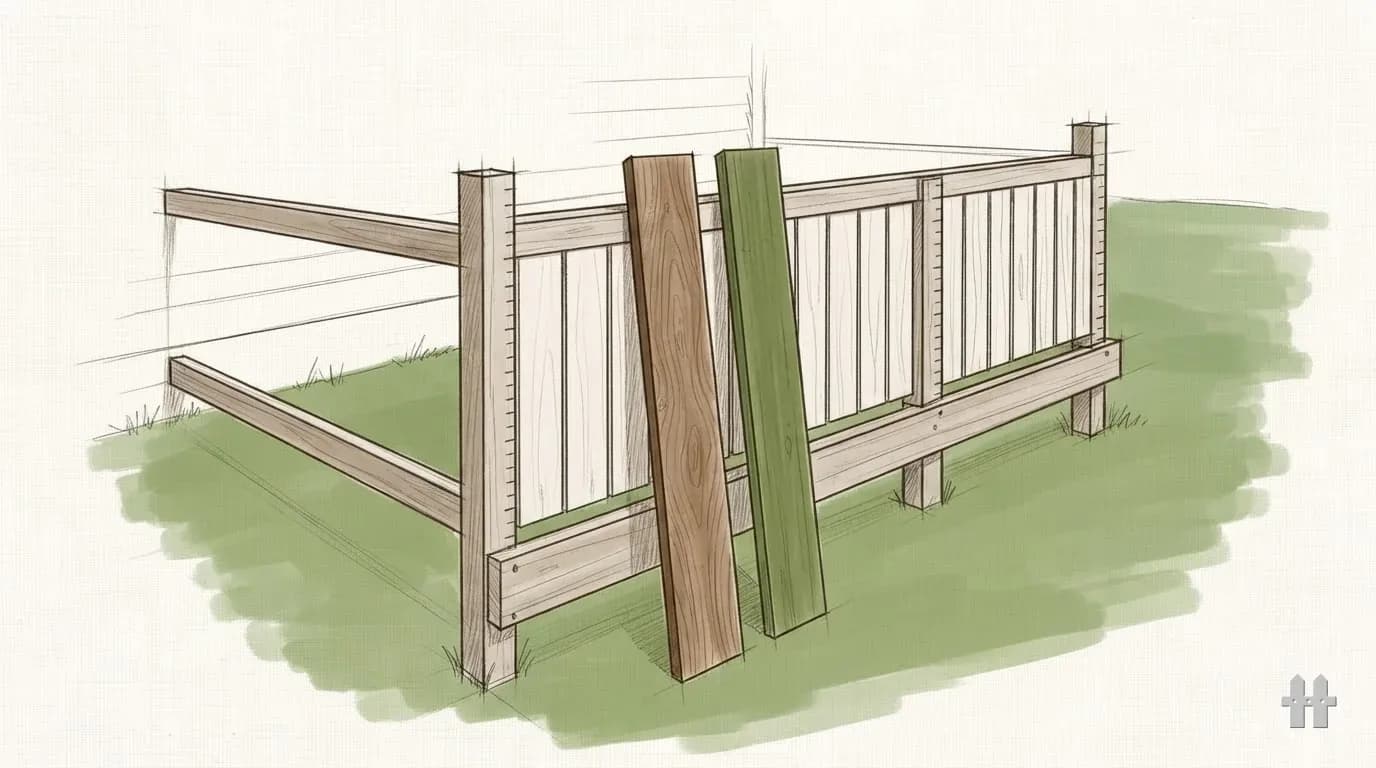
Our pick — Mixed build
| Criterion | Cedar | Pressure treated | Mixed build |
|---|---|---|---|
| Naturally decay resistant | Heartwood only | No — chemically treated | Where it counts |
| Correct below grade | |||
| Stays straight as it dries | Often not | ||
| Acceptable left unfinished | Not really | ||
| Takes stain well when dry | After it dries out | ||
| Needs corrosion-rated hardware | Advisable | Required | Required |
| Cost per foot | Higher | Lower | Between |
| Available as tall privacy stock |
Naturally durable heartwood, stable, and the better-looking board by a distance. Sapwood is not durable, so grade matters more than the species name on the tag.
Chemically protected softwood. Cheapest per foot and the correct choice below grade — but it moves, checks and twists as it dries.
Treated posts in the ground, cedar rails and pickets above. Each material where it is strongest, and what most fence contractors will suggest.
Cedar is naturally durable: the heartwood contains extractives that resist decay and insects. Treated pine is chemically durable: preservative forced into the wood does the same job. Both work, and they fail in different places.
Cedar's protection is in the heartwood only. The pale sapwood on the outside of the log has essentially none, and a budget cedar picket can be largely sapwood — which is why two cedar fences can behave completely differently. Treated pine's protection is in the treatment, and treatment comes in retention levels: an above-ground rating is not the same product as a ground-contact rating, and using the wrong one below grade is the commonest material mistake on a fence.
Cedar is the better board above ground: stable, straight, handsome, pleasant to work. Treated pine is the better post below ground: cheaper and rated for soil contact. Putting each where it is strongest costs less than an all-cedar fence and lasts longer than an all-treated one.
The one thing to watch is the join. Treated posts want corrosion-rated hardware, and that hardware is then in contact with the cedar too — so the whole fence gets hot-dip galvanised or stainless fasteners, not just the post connections. Mixing metals at the junction is how you get rust streaks down a new cedar fence in one season.
The gate is where the mixed build earns its keep: a treated gate post carries the swing, and the fence gate hardwareguide covers the hinges, latch and brace that go on it.
Treated lumber usually arrives wet with treatment, and it dries in place. As it dries it shrinks, checks along the grain, and — in a picket — can cup or twist. A treated fence that looked perfect on install day frequently looks wavy a summer later.
Cedar arrives drier and moves less. Pickets stay flat, gaps stay even, and the fence still looks like the fence you built. If the fence is the front of the house, that is worth real money; if it is the back boundary behind a hedge, it may not be.
Cedar left bare silvers to an even grey that most people find acceptable. Treated pine left bare greys unevenly and checks, and generally looks its age faster.
Either can be stained, and both want the same discipline: wait until the wood takes water, clean it, and use a penetrating finish that can be recoated without stripping. That is a recurring cost in material and days, and it belongs in the comparison alongside the per-foot price — the per-foot page explains how to build the number.
Prices move weekly and by region. Enter the unit price your yard quoted you — the defaults are round placeholders, not a market average.
Size the stain order for either wood, both faces and the frame, with the fence stain calculator.
Nothing here is asserted as a current figure. This page compares properties and trade-offs, and says how to get your own number where a price would have gone.
Filed under Fence building — 11 tools, guides and comparisons in this pillar.
Price both material choices over the same run.
The posts are where the material choice matters most.
The finish tiers apply to a fence too.
The other material question people ask next.
Service life by material, and what ends it first.