Fence gate hardware
Updated 2026-09-04 8 min read
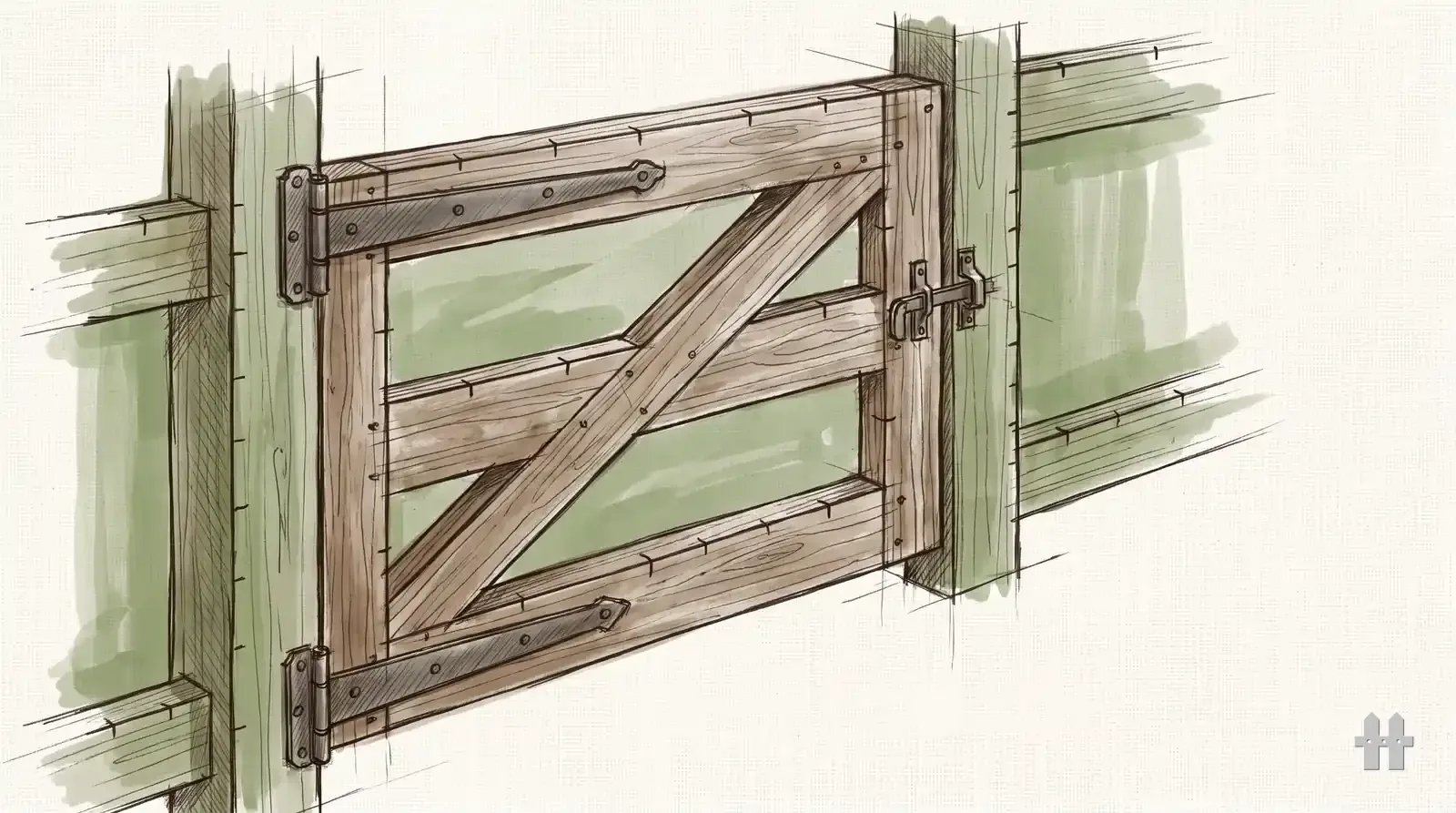
Why gates sag
A gate is a cantilever hanging off two points on one post. Gravity pulls the outer, latch-side corner down, and everything in the assembly is either resisting that or failing to. The sag comes from one of four places, in this order of likelihood:
The post leaned. The commonest cause and the one nothing else fixes. The gate is square, the post is not — see post depth.
The frame racked. A rectangle of four boards with a fastener at each corner is a parallelogram waiting to happen. Without a diagonal it will go out of square.
The brace runs the wrong way. Very common, and it does nothing at all — more below.
The hinge screws pulled. Short screws into end grain or into a single-thickness stile back out under a swinging load.
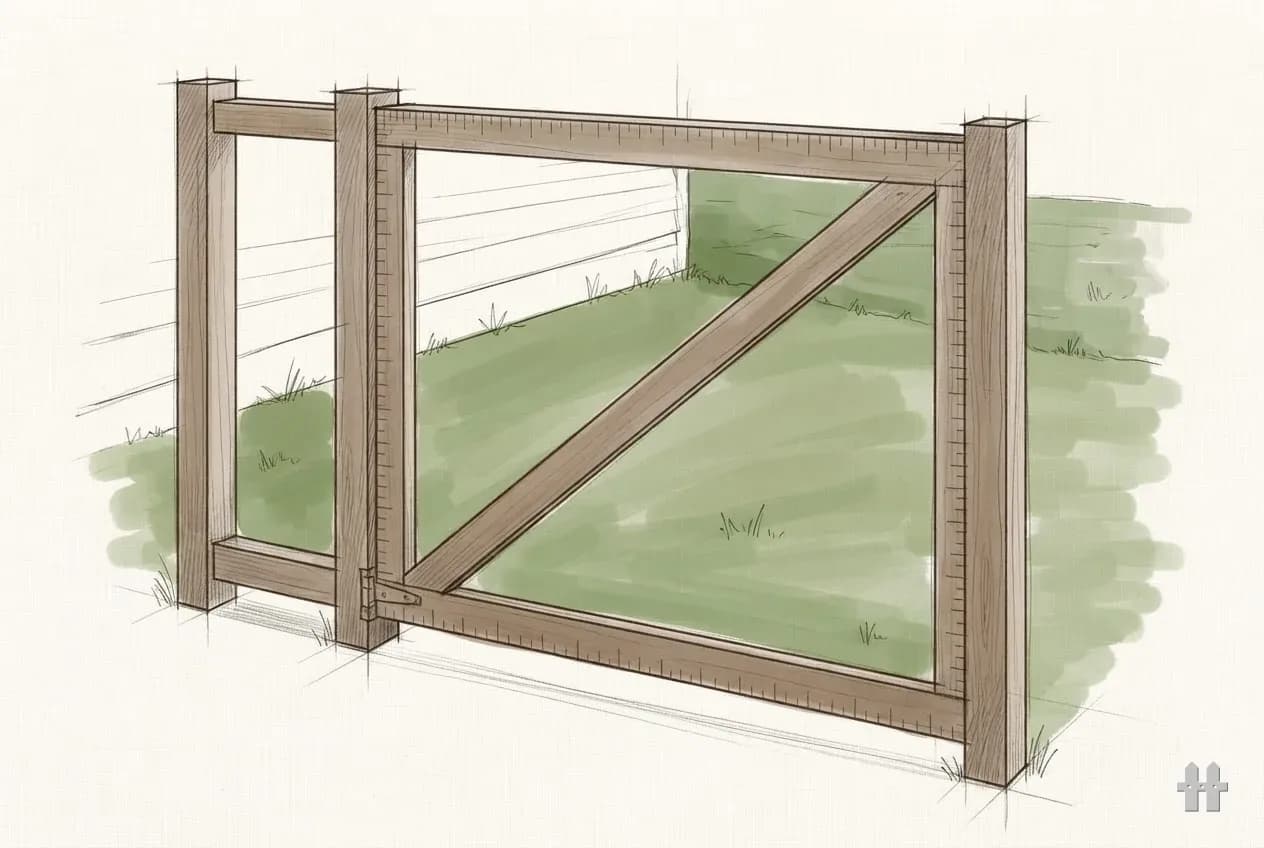
The brace, and the direction people get wrong
A wood diagonal brace works in compression. It has to run from the bottom of the hinge side up to the top of the latch side, so the weight of the latch corner pushes down the brace into the bottom hinge, and the bottom hinge pushes it into the post.
Run it the other way and you have asked a piece of timber to work in tension through two end-grain joints. It carries nothing, the gate sags anyway, and the brace sits there looking like it should be helping. If you are ever unsure: low corner at the hinges.
A steel cable-and-turnbuckle brace is the exact opposite — it works in tension, so it runs from the top of the hinge side down to the bottom of the latch side. Both are correct; each has one direction and they are opposites. Cut the wood brace to a tight fit at both ends so it bears rather than relying on its fasteners.
Hinges
Buy for the gate's weight and width with margin — hinges are the cheapest part of the assembly and the most expensive to change later. Long strap hinges spread the load across several boards instead of concentrating it at the stile.
Three hinges on anything heavy or over about four feet wide. Two hinges put the entire rotational load on two points; the third takes a large share out of the top one.
Through-bolt where you can. Carriage bolts with washers and nuts do not withdraw. Lag screws are second best and want to be long enough to reach real wood, not just the stile face. Never mount a hinge into end grain.
Adjustable or self-closing hinges are worth it on a gate that will be used daily — being able to take a quarter inch of sag out with a wrench in year three beats rehanging the gate.
Latches and drop rods
Pick the latch for how the gate is used, not for looks. A thumb latch works from both sides on a garden gate. A gravity latch tolerates a gate that has moved slightly, because the catch is forgiving. A ring latch is simple and cheap and will not hold against a dog leaning on it.
Mount the latch on the gate's latch stile and the keeper on the post, not the other way round, and leave enough clearance that seasonal swelling does not jam it shut in a wet week.
On a double gate, one leaf is fixed by a drop rod into a sleeve in the ground and the other latches to it. Sleeve the hole — a rod dropping into bare soil fills with grit and stops working in a season — and set the sleeve where water drains rather than at the low point of the driveway.
Pool gates are a different specification
A gate in a pool barrier is life-safety hardware, not garden hardware. The requirements are specific and inspected: self-closing from any open position, self-latching, opening away from the pool, with the release mechanism placed out of a small child's reach and no gap or handhold that lets one reach through to it.
Ordinary spring hinges and a thumb latch do not satisfy this, and neither does a self-closing gate that fails to latch when it closes gently. Get the requirement from your jurisdiction in writing before buying — details in fence permit rules.
Code requirement
Pool barrier gate hardware is a safety requirement enforced by your local authority. Confirm the current specification with them; do not copy an existing installation.
Finish and corrosion
Gate hardware lives outdoors on wet, chemically treated wood. Hot-dip galvanised is the baseline; stainless near salt air or a pool. Plain zinc-plated hardware from the bargain bin will bleed rust down a cedar gate within a season and the streak does not come off.
Keep the metal consistent — mixing stainless fasteners into a galvanised hinge, or the reverse, accelerates corrosion at the contact. And the same rating applies to the screws and washers, not just the hinge plate; a stainless hinge on plated screws fails at the screws.
Sources
Nothing here is asserted as a current figure. The numbers on this page are arithmetic or nominal lumber sizes — definitions, not claims.
Filed under Fence building — 11 tools, guides and comparisons in this pillar.
Next on the pile
How deep should fence posts be
The gate post is the one that has to be deeper.
Fence post calculator
Plan the gate opening into the post layout.
Do you need a permit for a fence
Pool barrier gates have their own rules.
Cedar vs pressure treated fence
What the gate frame should be made of.