Best value
Chain link
Least material per foot of any real fence, and it goes up fast on a long run.
Best value
Least material per foot of any real fence, and it goes up fast on a long run.
Longest life
Galvanised steel with no organic material to rot and nothing to repaint.
Lowest maintenance
Effectively none. Wood needs a finish cycle it will not get.
Our pick — Wood
| Criterion | Chain link | Wood |
|---|---|---|
| Blocks the view | ||
| Blocks wind and some noise | ||
| Contains a dog | ||
| Lets light and air through to planting | ||
| Needs a finish | ||
| Rots | ||
| Wind load on posts | Low | High |
| Easy on a steep slope | Steps or racks | |
| Repair a damaged section | Patch or re-stretch | Replace boards |
| Adds to a garden's look |
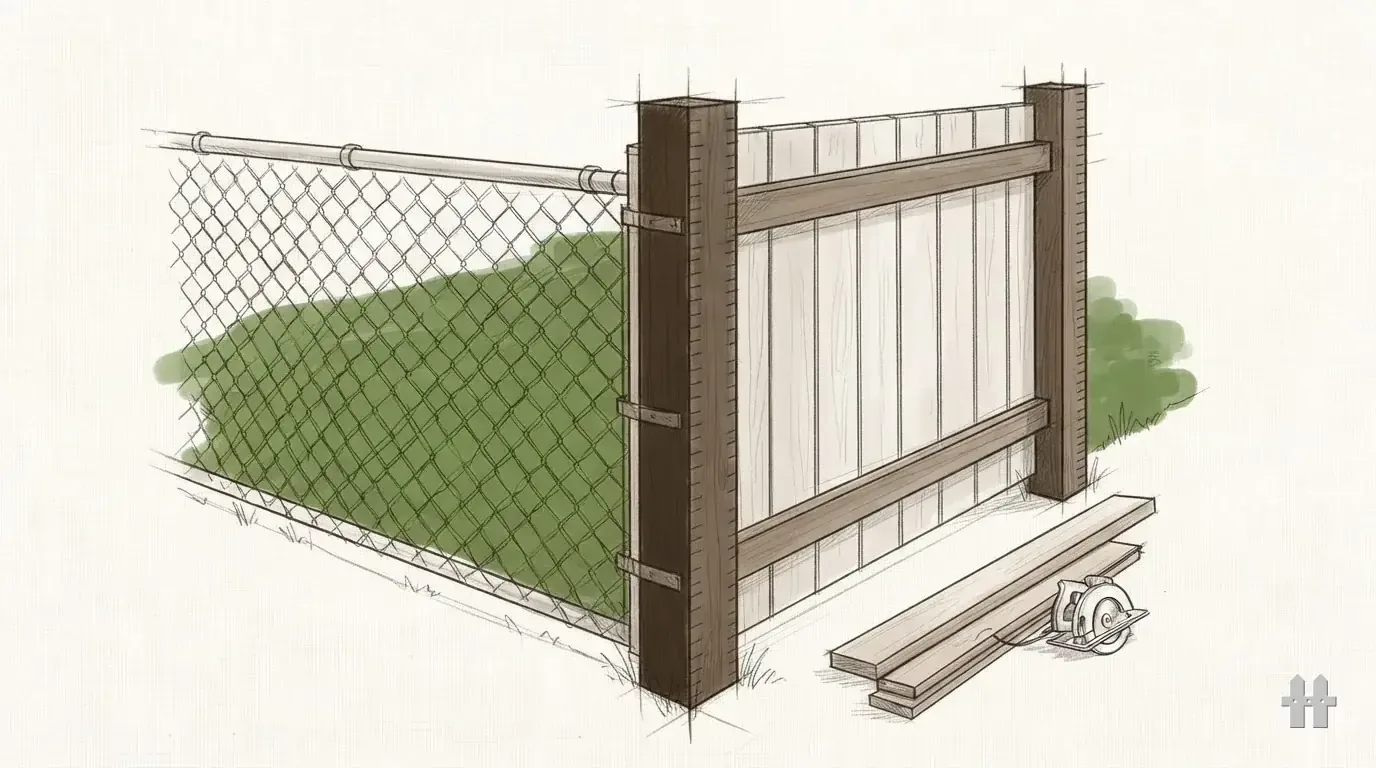
Woven wire on steel. Cheap, durable, transparent — which is either the point or the problem, depending on the job.
Boards on rails. Costs more, needs keeping, and does the one thing chain link cannot do at all.
Most comparisons treat this as a quality ladder with chain link at the bottom. It is not. They are two answers to two different questions, and picking well starts with being honest about which question you have.
Containment — keep a dog in, keep the yard defined. Chain link does this as well as anything and for less money. Privacy — stop people seeing in, cut the wind, quiet the road. Chain link cannot do this at all; slats are a compromise that looks like a compromise. A fence bought for privacy that is not private is a wasted fence at any price.
Long runs on a budget. Fencing a large rear boundary or a paddock in wood is a serious number; in chain link it is achievable.
Steep or awkward ground. The fabric follows a slope continuously. A board fence has to step — leaving triangular gaps — or be racked panel by panel.
Where a solid fence would be a sail. On exposed sites the wind load of a privacy fence drives bigger posts, deeper holes and more concrete. Chain link barely catches the wind and its footings can be sized accordingly.
Where you want light through. A solid fence on the south side of a vegetable garden shades it. Chain link does not.
Privacy slats. They add partial screening and they add wind load to a fence whose posts were sized for none. On a new fence, tell the installer up front. On an existing one, ask before you weave them in.
Vinyl-coated fabric. Black or green coating makes chain link far less visually intrusive — the eye reads through it to the planting behind. It is a modest uplift in cost and the single best-value improvement available to a chain link fence.
Planting. A hedge or climber on a chain link line gives privacy in a few seasons at a fraction of the cost of a board fence — and the fence gives the planting something to grow on while it establishes.
A common and sensible answer: wood along the street frontage and the patio side where it is seen and where privacy matters, chain link along the back and side boundaries where it is not. You pay for privacy only where you get value from it, and the total lands well under an all-wood run.
Check the ordinance before assuming chain link is allowed on the visible sides — front yard restrictions are common, and HOAs frequently ban it altogether. Details in fence permit rules.
Prices move weekly and by region. Enter the unit price your yard quoted you — the defaults are round placeholders, not a market average.
Nothing here is asserted as a current figure. This page compares properties and trade-offs, and says how to get your own number where a price would have gone.
Filed under Fence building — 11 tools, guides and comparisons in this pillar.
Price a run either way with your own numbers.
If privacy is the point, price it properly.
Where chain link is and is not allowed.
The other low-maintenance option.
Count every part and price it with your yard's numbers.