Picket
4' · 3" gapSpaced boards with a shaped top. Lowest board count of the four, marks a boundary without closing it, and the traditional front-yard answer where the ordinance caps the height.
Four styles, drawn as elevations rather than photographed, because what matters when you are pricing is the framing — how many boards, how much rail, and how much wind the finished face will catch.
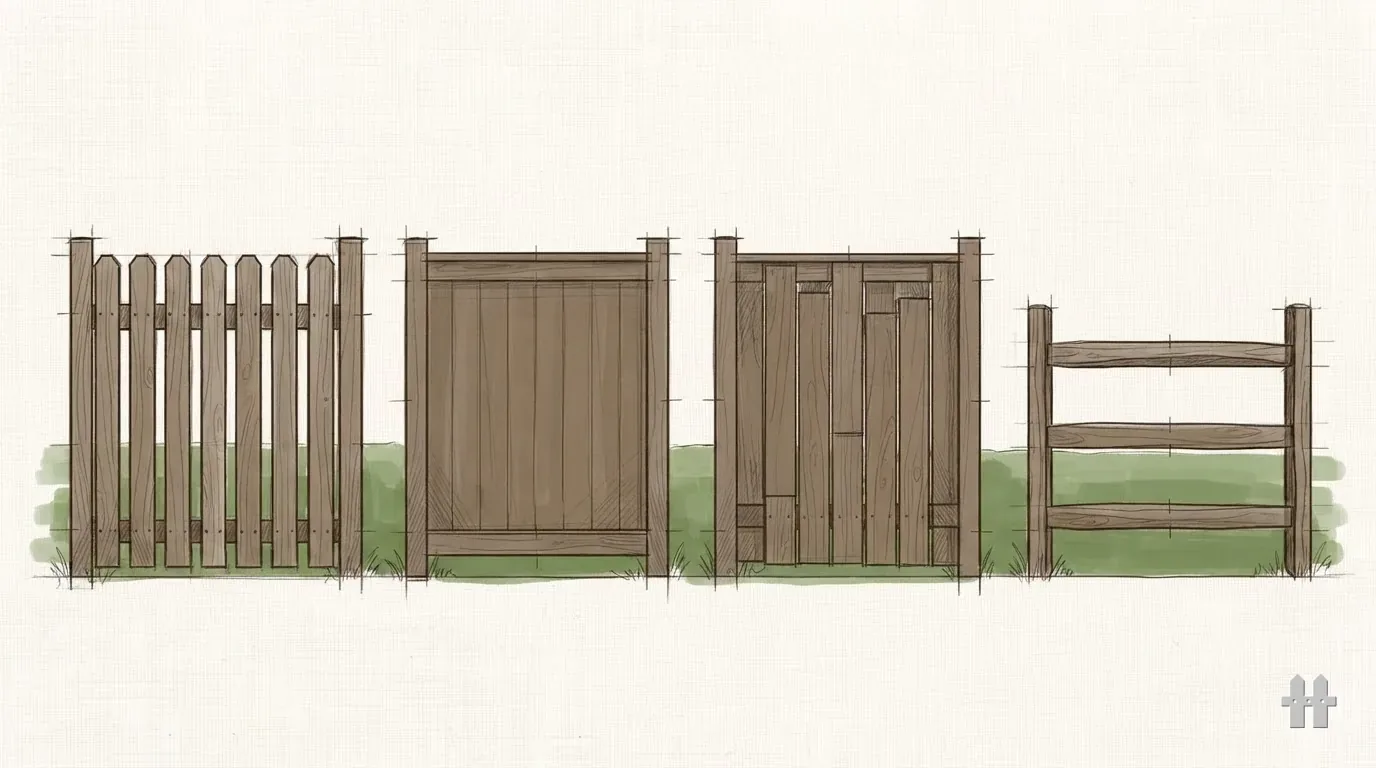
Spaced boards with a shaped top. Lowest board count of the four, marks a boundary without closing it, and the traditional front-yard answer where the ordinance caps the height.
Boards butted tight for a solid face. Full privacy, the highest board count of the solid styles, and a solid sail — so it wants the deepest posts and the most concrete.
Alternating boards either side of the rail. Looks finished from both sides, lets air through, and uses roughly twice the board of a solid fence.
Posts and rails only. Cheapest per foot by a distance, defines a line rather than enclosing it, and pairs well with wire mesh where an animal has to be contained.
Over the same run these four are separated by a factor of several, and almost none of that is the post line — it is board. Shadowbox uses about twice what a solid privacy fence uses; split rail uses a fraction of either. Price the style you actually want on the privacy fence calculator before you settle on it.
Height and location are decided for you more often than people expect. Front-yard limits are usually lower than rear ones, corner lots have a sight triangle, and a fence round a pool is a different specification entirely — all in fence permit rules.