Deck ledger board and flashing
Updated 2026-10-23 8 min read
Why this detail matters more than the rest
An undersized joist sags. A badly attached ledger drops a deck full of people off the side of a house, and it is the failure mode that shows up again and again in collapse investigations. The ledger carries half the deck's entire load into a wall that was never built to hold it sideways.
The second failure is slower and more common: water gets behind the ledger, sits against the rim joist of the house, and rots the structure from inside the wall. By the time anything is visible the sheathing is gone. Both failures are prevented by the same two things — the right fasteners into the right framing, and flashing that laps the way water falls.
Code requirement
A deck ledger is a structural connection with a prescriptive fastener schedule in IRC 2021 R507.9. Your jurisdiction may amend the model code or adopt a different edition. Confirm with your building department before you cut.
What the ledger attaches to
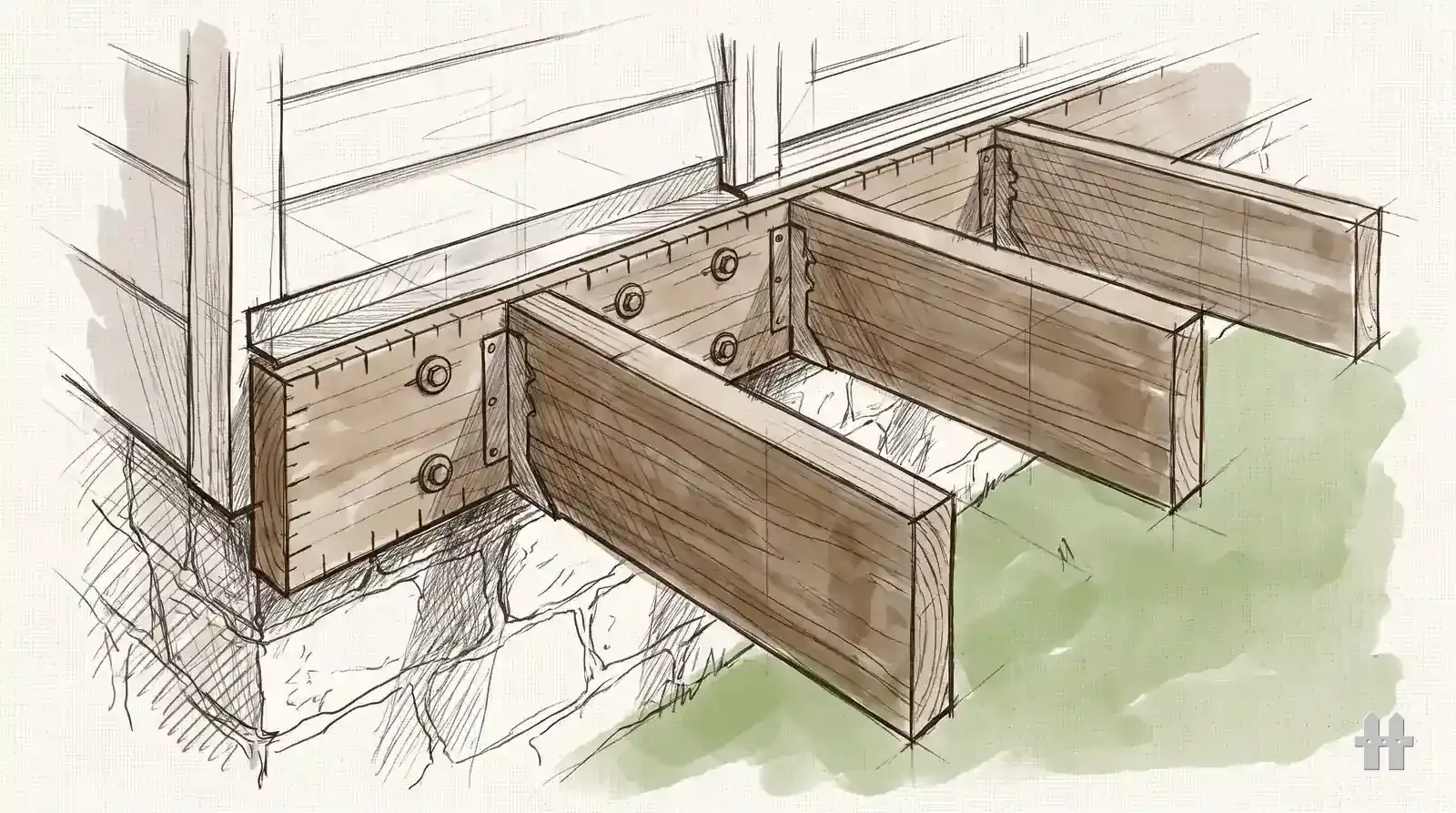
The ledger must land on real structure — the house's band or rim joist, or studs, or a solid concrete or masonry wall with the right anchors. Sheathing is not structure. Siding is emphatically not structure. Neither is a cantilevered floor overhang, a brick veneer, or a stucco skin over foam.
That means the siding comes off in a band wide enough to expose the rim, the ledger goes against the sheathing or the framing itself, and the wall gets closed back up around it. If you cannot see what you are bolting into, you do not know what you are bolting into.
Brick veneer, stone, EIFS, cantilevered rooms and some engineered rim products cannot take a ledger at all. Those decks get freestanding — posts and a beam along the house side, no connection to the building. It is more digging and it is the right answer.
The joists hung from it are sized from the deck joist span chart, and the posts at the far end from the footing size calculator. The beam they carry sets the spacing for deck posts.
Fasteners
Through-bolts, lag screws or an evaluated structural screw — in a staggered pattern, at the spacing the adopted table gives for your joist span and ledger size. Closer spacing for longer spans, because the ledger is carrying more.
The spacing is not a judgement call and it is not "every 16 inches" from memory. Pull up the table your jurisdiction adopted and read the row. Then keep the fasteners out of the ends of the board and off the edges by the distances the table gives; a bolt too near an end splits the ledger and carries nothing.
Everything in contact with treated lumber has to be rated for it. Ordinary zinc plating corrodes fast against modern preservative chemistry — hot-dip galvanised or stainless, and the same rating for hangers, washers and the fasteners into them.
Flashing, in order
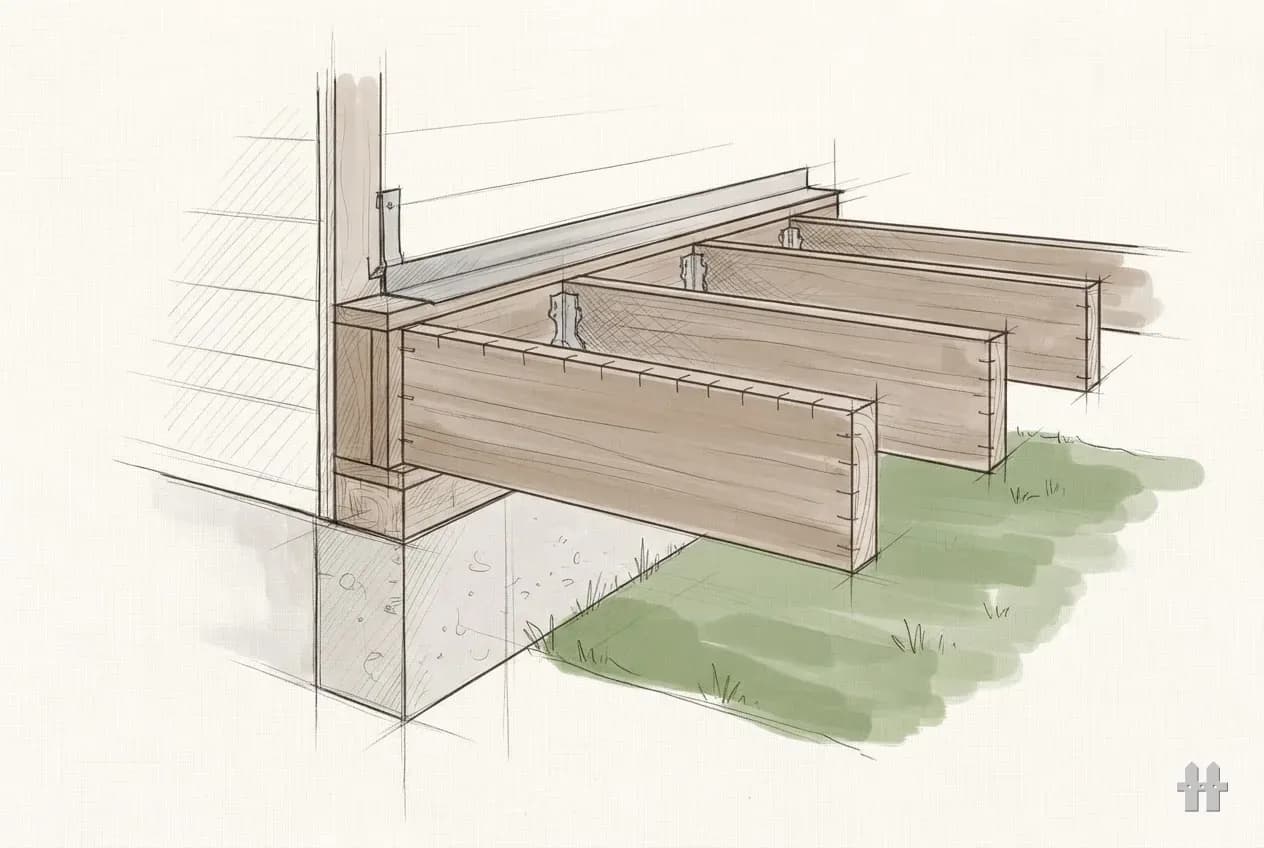
Flashing works by gravity and lapping, not by sealant. Water runs down the wall, and every layer must overlap the one below it so the water stays on the outside. The order, bottom to top:
- 01Wall drainage plane exposed and intact. Repair any tears before anything else goes on.
- 02Self-adhered membrane behind the ledger. It protects the sheathing where the ledger will sit and seals around each fastener as it goes through.
- 03Ledger fastened. Straight, level, and to the schedule.
- 04Cap flashing over the ledger's top edge. It turns down over the face of the ledger and its top leg goes UP the wall behind the drainage plane above.
- 05Housewrap lapped over the flashing's upstand. This is the step that gets reversed most often, and reversing it funnels water straight in behind the ledger.
- 06Siding back on, with a gap. Do not seal the bottom of the assembly shut. Water that gets in has to get out.
Many builders also set the ledger on spacers so there is a drainage gap behind it, with the fasteners sleeved through. Where it is allowed it is a real improvement, because the back of the ledger can dry.
Four things never to do
Never nail a ledger on and call it done. Nails in withdrawal are what fails.
Never fasten through siding. The gap behind it means the fastener is in bending, and the cavity fills with water.
Never rely on caulk instead of flashing. Sealant is a maintenance item with a service life; flashing is a shape that works forever.
Never bolt into an unknown. If you cannot confirm the rim joist is there and sound, open the wall or go freestanding.
When the ledger is right, the rest of the frame follows — the joist layout hangs off it and the footings take the other half.
Sources
Filed under Deck framing & structure — 19 tools, guides and comparisons in this pillar.