Best value
Pressure-treated wood
Lowest cost to build by a wide margin, and every board is replaceable one at a time.
Best value
Lowest cost to build by a wide margin, and every board is replaceable one at a time.
Longest life
It does not rot. The frame underneath still ages, but the surface effectively stops being a maintenance item.
Lowest maintenance
Wash it. No sanding, no stripping, no recoating cycle.
Our pick — Composite
| Criterion | Wood | Composite |
|---|---|---|
| Rots | Yes, if detailed badly | No |
| Needs staining | Yes, on a cycle | No |
| Splinters | Yes, as it weathers | No |
| Can be sanded back | ||
| Single board replaceable | Yes, if the line is still made | |
| Hot in direct sun | Less | More, especially dark colours |
| Own joist spacing rule | Standard | Per manufacturer |
| Hidden fasteners available | Some profiles | |
| Warranty on the surface | Usually, with conditions | |
| Frame still ages normally |
Treated pine, cedar or redwood. Cheapest to build, warmest underfoot, and endlessly repairable — at the cost of a recurring finish job.
Capped wood-polymer boards. Higher up front, close to nothing after, and unforgiving if a board gets damaged.
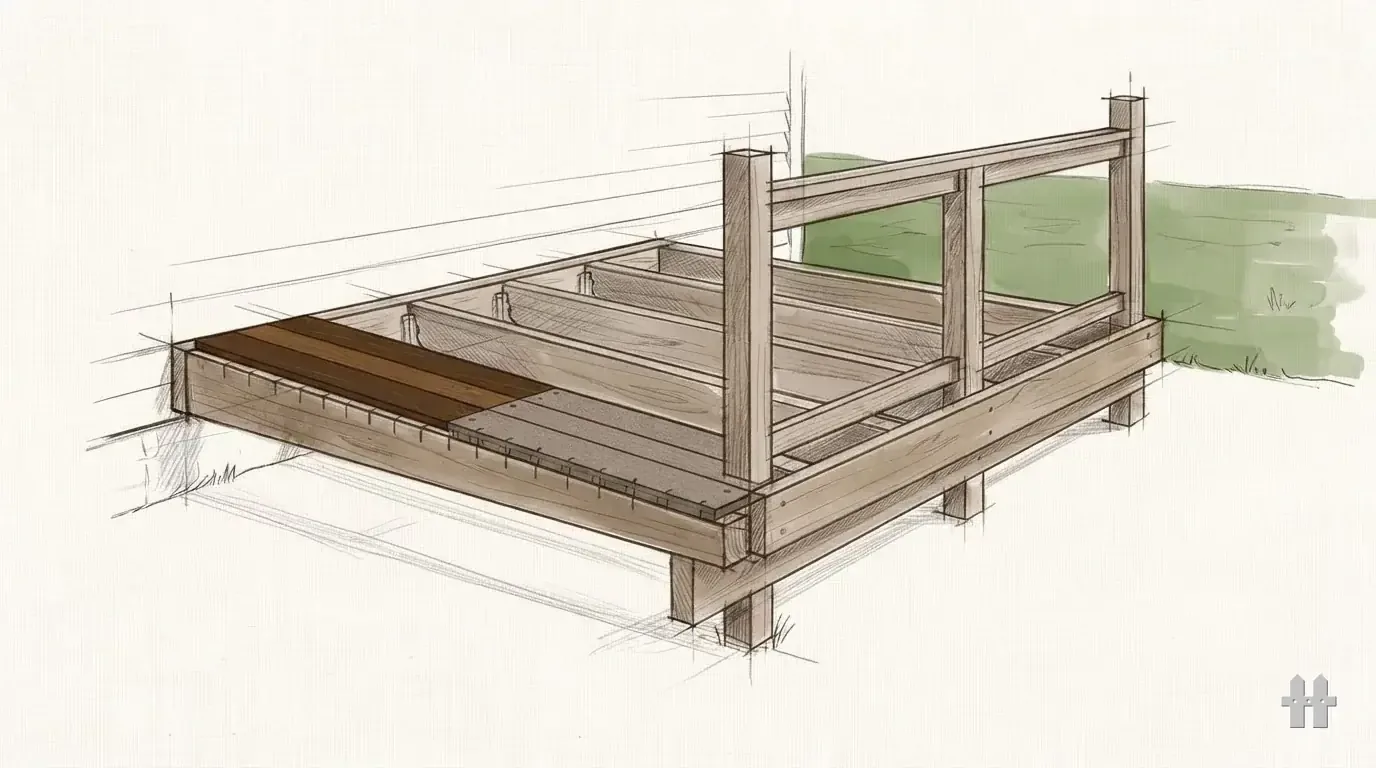
Almost nobody is choosing between a composite deck and a wood deck. They are choosing between two surfaces on the same frame. The footings, posts, beam, joists, ledger and guard posts are treated lumber either way, and they are a large share of the cost and all of the structural risk.
That reframes the money. The composite premium applies to the decking boards and their fasteners, not to the deck. It also means composite does not extend the life of the deck — it extends the life of the part you walk on, while the frame ages exactly as it would have.
The standard argument is that composite costs more to build and less to keep, so it wins over ten years. That is sometimes true and it depends entirely on numbers this page cannot know: your local material prices, your local labour rate, and whether you would actually have re-stained the wood on schedule.
The honest method is to build both totals yourself. Take the same deck, price the material both ways at your yard's current numbers, then add a realistic maintenance line for the wood option — stain material plus either a contractor's day rate or your own weekend, at whatever interval your climate demands. Both cost tools are set up for that.
Prices move weekly and by region. Enter the unit price your yard quoted you — the defaults are round placeholders, not a market average.
For the composite side of that sum, run your own quotes through the composite deck cost calculator.
Heat. Composite absorbs and holds solar heat more than wood, and dark colours more than light. On a south-facing deck in full sun this is the difference between a surface you can stand on barefoot in August and one you cannot. Get a sample and test it on site, in the sun, before committing.
Repairability. A wood board that gets gouged, burned or stained can be sanded, or swapped for another board that will weather to match. A capped composite board cannot be sanded — the cap is the product — and a replacement from a different production run, or a discontinued line, will not match. One dropped barbecue is a permanent feature.
The frame matters too. Each composite maker sets its own joist spacing, square and diagonal; they are collected in joist spacing for composite decking.
Wood if the budget is the constraint, if you like the material and do not mind the ritual of maintaining it, if the deck is in strong sun and bare feet matter, or if the deck is likely to be extended or altered later.
Composite if you will not do the maintenance and know it, if the deck is hard to access for recoating, if splinters are a real concern, or if the deck has to look the same in ten years with no effort beyond a wash.
Either way, spend the saved argument on the frame. A composite surface on a badly detailed frame fails at the ledger just as fast as a wooden one.
Nothing here is asserted as a current figure. This page compares properties and trade-offs, and says how to get your own number where a price would have gone.
Filed under Materials & finishes — 11 tools, guides and comparisons in this pillar.
Price the composite option against the same frame.
Whole-deck cost with your own unit prices.
When the decking, not the joist, sets the spacing.
All four materials, not just these two.
Why the frame's clock is the one that matters.